Sheen boom vs. containment boom: what the difference is at a berth
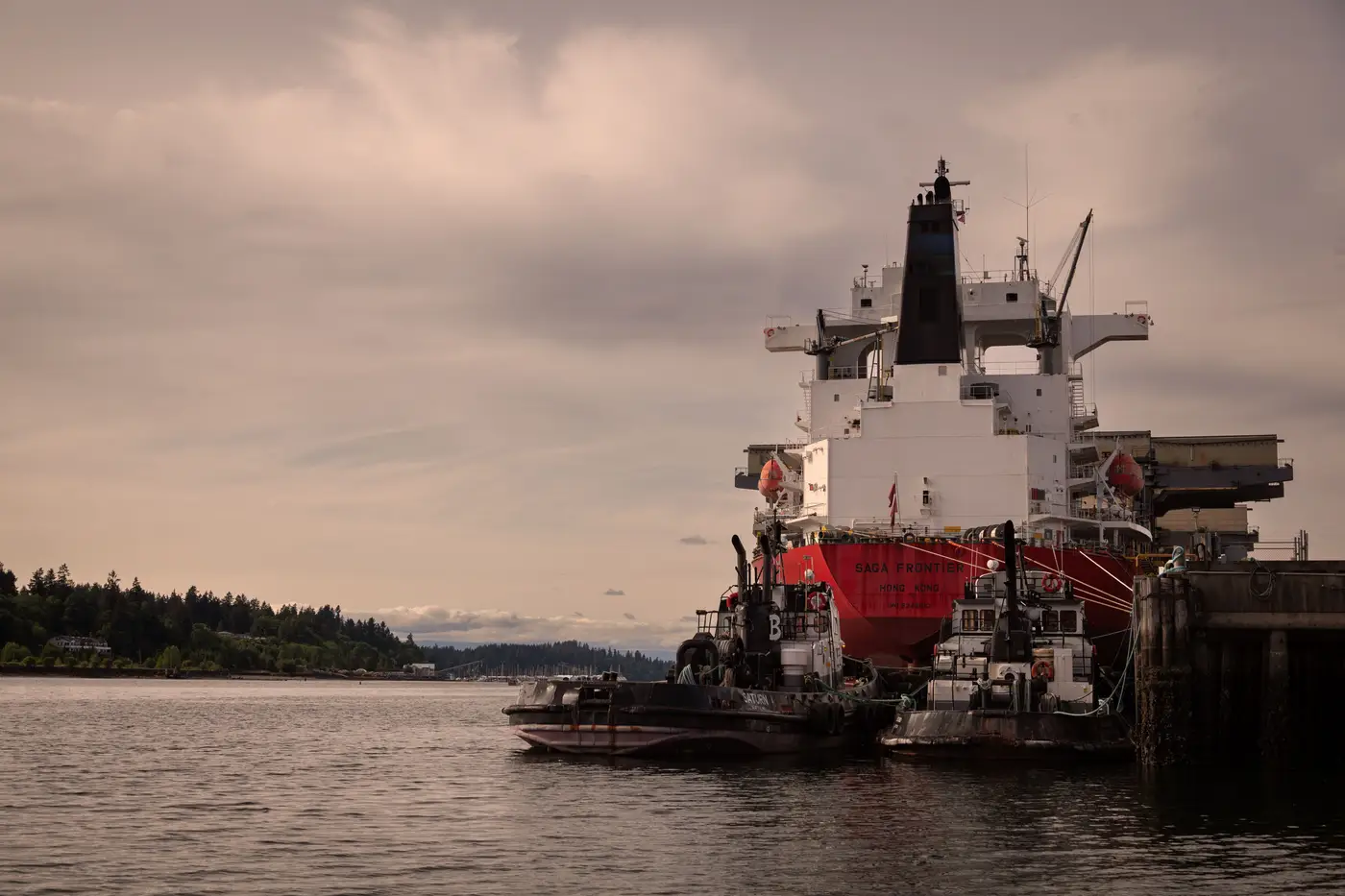
If you've pulled a spill response plan off the shelf, you've seen both terms in the equipment list: sheen boom and containment boom. They get used almost interchangeably on a radio call, and that's where people get into trouble. They're built for different jobs, and picking the wrong one near a berth wastes time you don't have.
What a sheen boom does
A sheen boom is a lightweight boom, usually a thin absorbent or hydrophobic strip with modest freeboard and almost no draft below the waterline. It's made to ride on top of the water and pick up or deflect a thin film, the kind of iridescent sheen you get from a slow weep at a flange, a loose hose coupling, or bilge discharge nobody caught in time. It doesn't hold back volume because there's no volume to hold back. A sheen has no real thickness to speak of. The boom's job is to keep that film from spreading past a line you've drawn, often tied off from a mooring cleat or a piling, not to dam up product.
Most sheen boom is some flavor of sorbent material, which is why people lump "sheen boom" and "sorbent boom" together. That's close enough for a dock conversation but not quite right on paper.
Where containment boom fits, and where sorbent boom fits inside that
Containment boom is the heavier gear: a floating skirt with real freeboard above the water and a weighted curtain or skirt hanging below it, built to resist current and hold back a slick that has real depth and volume. This is what you deploy for a hull breach, a transfer line failure, or anything where product is accumulating on the surface rather than just filming it. Containment boom needs anchors, needs slack for tidal exchange, and needs enough freeboard that chop doesn't wash oil over the top.
Sorbent boom is a subcategory, not a rival category to either of the above. Some of it is built light, for sheen work. Other sorbent boom comes heavier, with a sewn or netted casing around polypropylene fill, meant to work alongside containment gear, soaking up whatever gets past the containment line or cleaning up the thinner edges of a slick after the thick part's been skimmed. On a lot of terminal response kits, you'll find it staged as the second line, right behind the containment skirt, for exactly that reason.
Deployment near a berth: what changes
Deployment at a berth means working around piling clusters, fender systems, mooring lines, and a hull that's either alongside or swinging on her lines with the tide, conditions open water doesn't hand you. Most terminals pre-rig a boom reel or a J-boom configuration at the berth specifically so a crew doesn't have to improvise anchor points under pressure. Current direction at the berth usually comes off the river or channel flow more than wind, so the deployment angle gets set around holding the boom roughly perpendicular to flow, with enough slack to flex rather than get overrun.
For a sheen, that pre-rig is often oversized for the job. You don't need a full containment spread with anchors set against three-knot current to deal with a film that's a few molecules thick. A sheen boom, or a length of light sorbent boom, tied from the vessel to a shore cleat is usually enough to hold the line while the real question gets answered, which is how far the film has spread and whether it's still growing.
That question, how far it's spread, is the one a visual check from the dock answers badly. Sheen on water looks different by the minute depending on sun angle and surface chop, and a walk-down at the waterline tends to undercount the edges. That's the gap daylight satellite imagery fills, reading sun-glint and spectral contrast across the full water surface to lay the sheen's outline on a dated map instead of a guess, which is the kind of thing worth having ready before the report is due. If you're filing that extent report the moment a sheen's called in, Oil Sheen Detect builds the outline, area estimate, and source frame into one sheet.